The World Behind Harriet
Black life, community, and everyday experience in West Virginia coalfields, 1928-1930.
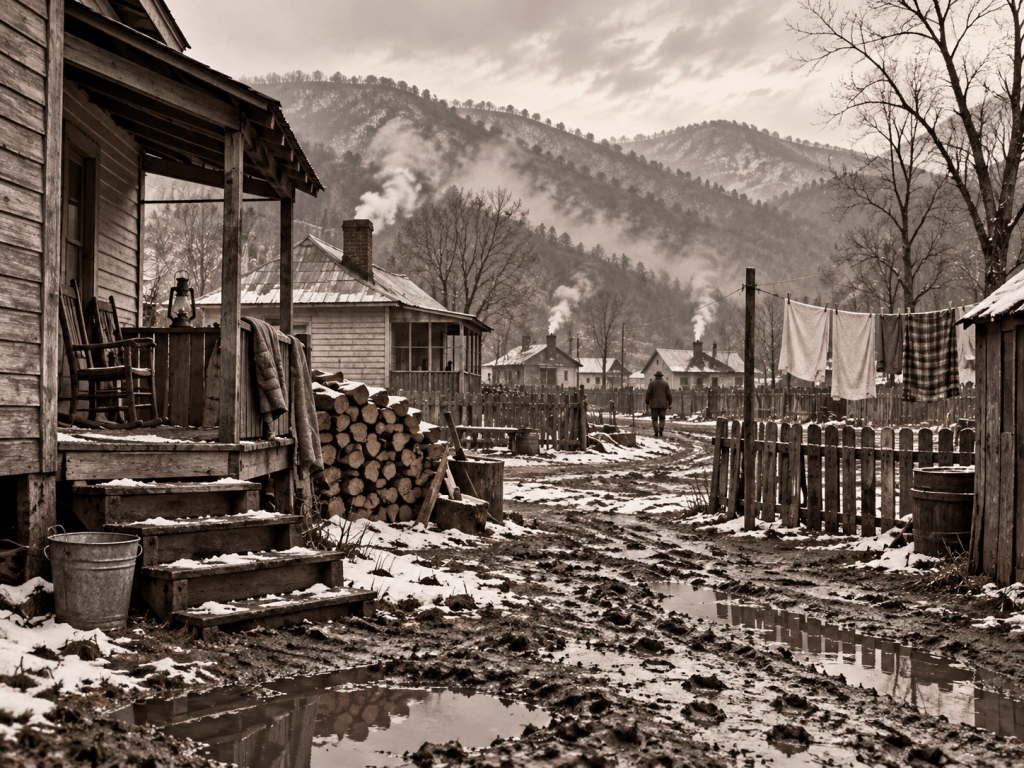
Much of the history of West Virginia’s coalfields has been preserved through accounts of mining disasters, labor disputes, and industrial expansion. The families who lived alongside these events had lives that extended far beyond the mines: raising children, attending churches, preparing meals, and building communities in a region undergoing tremendous change.
The historical research behind Harriet, a novel in progress, explores these less frequently examined dimensions of Appalachian life, particularly the experiences of Black families in southern West Virginia during the late 1920s.
The Cobbler in the Coalfields
On April 4, 1930, a census enumerator recorded the household of Dezera B. Cameron in Logan County, West Virginia. Among the entries was one particularly revealing detail: Dezera was not a coal miner. He was a shoe cobbler, working on his own account in what the census described as his “own shop.”
This small discovery offers a different perspective on life in West Virginia’s coalfields. Mining dominated the regional economy, but the communities surrounding the mines required countless other forms of labor. Shoes needed repairing, clothing needed sewing, businesses needed tending, and households required care. The people who performed these tasks were as much a part of the coalfields’ history as the men who worked underground.
The census left much unanswered. Where was Dezera’s shop located? Did he repair the work boots of miners, the shoes of schoolchildren, or both? Who were his customers? A single census entry establishes his occupation, but reconstructing the daily life surrounding that occupation requires other sources.
The Cameron Family in the 1930 Census
One of the most important surviving records for Harriet’s historical world is the 1930 federal census. It places the Cameron family in Logan County and records details about household size, rent, birthplace, and work. Like all census records, it reveals some facts clearly while leaving many questions unanswered.
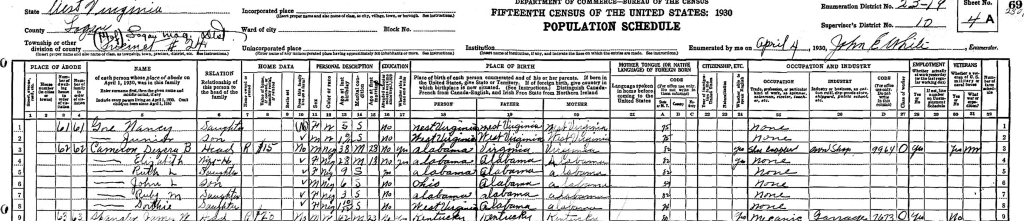
Source: 1930 U.S. Census, West Virginia, Logan County, Enumeration District 23-19, Sheet 4A, lines 3–8.
Beyond occupation, the census reveals the circumstances of the Cameron household. Dezera and Elizabeth lived with their four children—Ruth, John, Ruby, and Dorthie—in a rented home costing fifteen dollars a month. The family had no radio recorded. The children’s birthplaces are particularly interesting: two were born in Alabama, one in Ohio, and the youngest in West Virginia. These details suggest a family history of movement that the census alone cannot fully explain.
For a fuller transcription and notes, see the downloadable research sheet below.
Beyond the Cameron Household
The census offers more than a record of one family. Following the enumerator’s route reveals a community of miners, tradesmen, domestic workers, and families with young children. Some residents rented their homes, while others owned property. Their occupations and living arrangements suggest an economy that extended beyond the coal mines themselves.
Of particular interest is the sequence of Black and white households recorded near the Camerons. Although segregation shaped life throughout the coalfields, the census enumerator encountered families of both races in close succession. The record does not establish the precise distance between their homes, nor does it tell us whether these families shared friendships, churches, or other social relationships.
Two of the Black households in this section were recorded as homeowners, with properties valued at approximately $4,000 and $1,500. These figures represent estimated property values rather than earnings. Their presence complicates any assumption that every Black family in the coalfields lived in rented company housing.
The census cannot tell us what conversations took place between these households or how their relationships developed. It does, however, provide a starting point for investigating the social and economic lives of the people who inhabited this community.

